
Why Your Face Can Look Puffy (and What Helps
You look in the mirror, and your face is doing something different than it did last night. It feels heavier. The cheeks look fuller. Your eyes are a little swollen. There is a softness to the jawline that was not there before you went to bed. You did not drink. You did not eat anything salty. So what happened?
The short answer: your lymphatic system had a slow night.
What the lymphatic system actually does in the face
Your lymphatic system is a network of vessels that runs underneath the skin. Its job is to pick up fluid, bacteria and waste from your tissues and move them out of the body. Unlike your blood, which has a heart pumping it around, lymph has no pump. It moves when you move. It moves when you breathe deeply. It moves when the muscles around it contract and release.
In the face, that movement is small and slow. The lymph nodes that drain your face sit around the ears, behind the jaw, along the collarbones, and at the base of the skull. When any of those areas are tight, fluid piles up behind them.
Why it slows down
A few things stall facial drainage:
· A clenched jaw overnight. If your masseter is gripping, the lymph nodes around your jawline cannot do their job.
· Shallow breathing. The diaphragm is one of the biggest pumps for lymph in the body. When you are stressed or hunched at a desk, it barely moves.
· Sleeping mostly on one side. That side tends to be puffier in the morning.
· Alcohol, salt, and hormones. All affect fluid balance.
· Tight scalp and neck muscles. The face drains through the neck. If the neck is blocked, the whole system backs up.
Most of the time, facial puffiness is not really about your face. It is about everything around it.
Signs your drainage is sluggish
· Morning puffiness that takes hours to settle.
· Heaviness around the eyes.
· A dull, flat look to the skin.
· Your face feels tender when you press on it.
· Jaw soreness when you wake up.
What helps
Day to day:
· Deep breathing in the morning. Even two minutes.
· Gently warm water or a quick shower. Temperature change moves fluid.
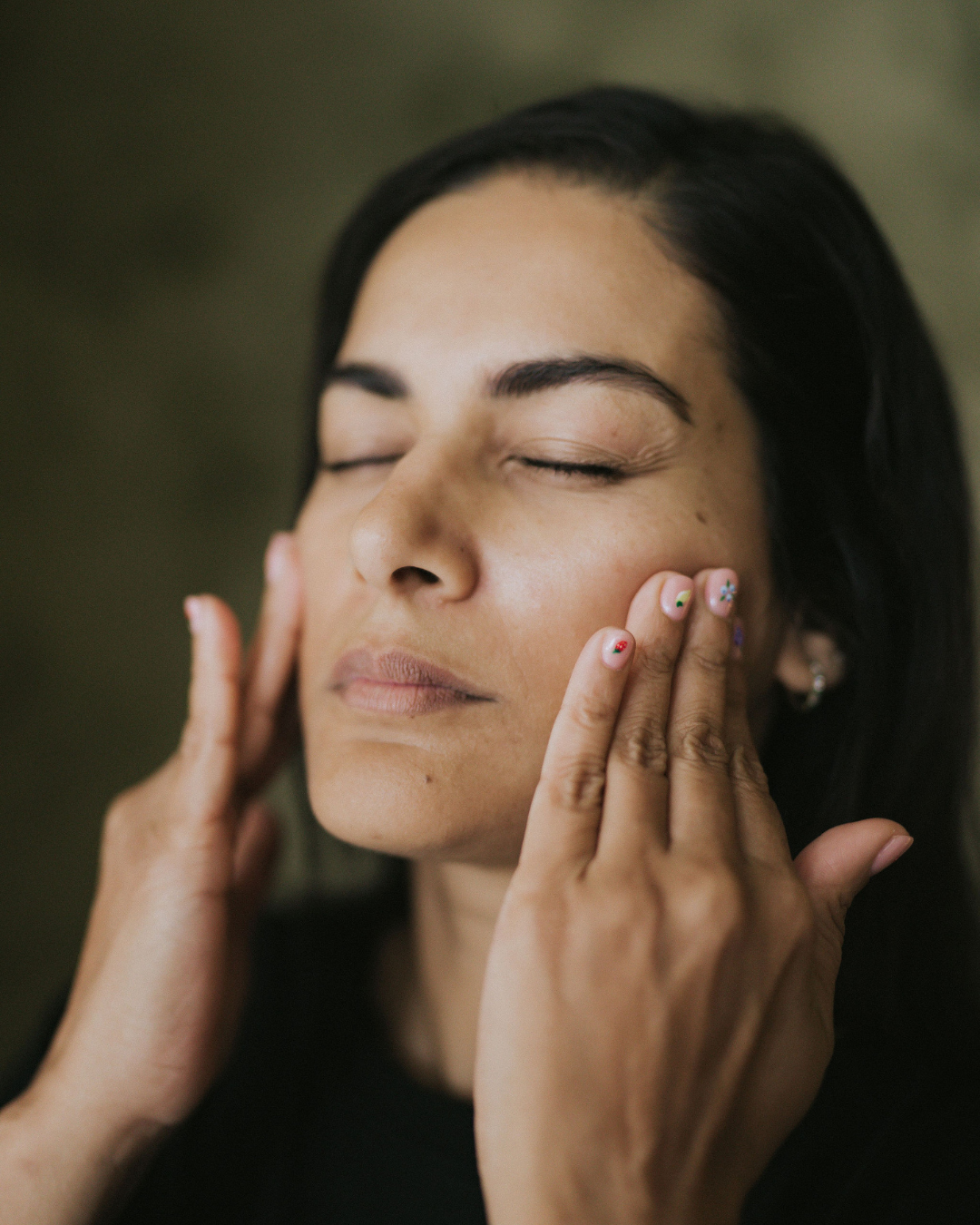
· A one-minute self-massage with light pressure, always moving from the centre of the face outwards, and from the neck down to the collarbones. Never push up. Fluid drains down.
Weekly to monthly:
· A proper sculpting massage where the practitioner opens the drainage pathways in the neck first, then works through the face. This is what FaceUp Massage does.
Why FaceUp Massage is different
A lot of facial treatments focus on the surface of the skin. Serums, peels, masks. They can be lovely. But if your face is holding fluid, no surface product will shift it.
FaceUp Massage starts with the neck. Then it works the jaw. Then it moves through the cheeks, temples and scalp. By the end, the fluid that had nowhere to go has somewhere to go. Most clients feel lighter before they even look in the mirror.
A 2-minute morning self-massage
1. Press gently below your collarbones with flat fingers. Five slow pumps.
2. Sweep down from behind your ears to your collarbones. Five times each side.
3. From the middle of your chin, slide along your jawline up to the ear. Five times.
4. From the sides of your nose, sweep out along the cheekbones to the temples. Five times.
That is it. Two minutes, done in the bathroom.
If the puffiness is most mornings
If your face has felt heavy most mornings for the last few weeks, self-massage will take the edge off but it will not clear the backlog. A full FaceUp Massage does in an hour what self-massage does in a week. Book a session with the link below. The team will work the drainage pathways that have been stuck, and you will feel it before the session is over.